

Asus ROG Zephyrus GX501 review: The thinnest, fastest gaming laptop - ingramcabon2002
The Asus Republic of Gamers (ROG) Zephyrus GX501 had us at "GTX 1080 artwork in a five-pound laptop computer that's all but as melt off as a MacBook In favour of 15." Pound for Irish pound, this is the most powerful takeout gaming laptop happening earth today. But to get this much performance in a laptop this take-away, some big compromises have been made.
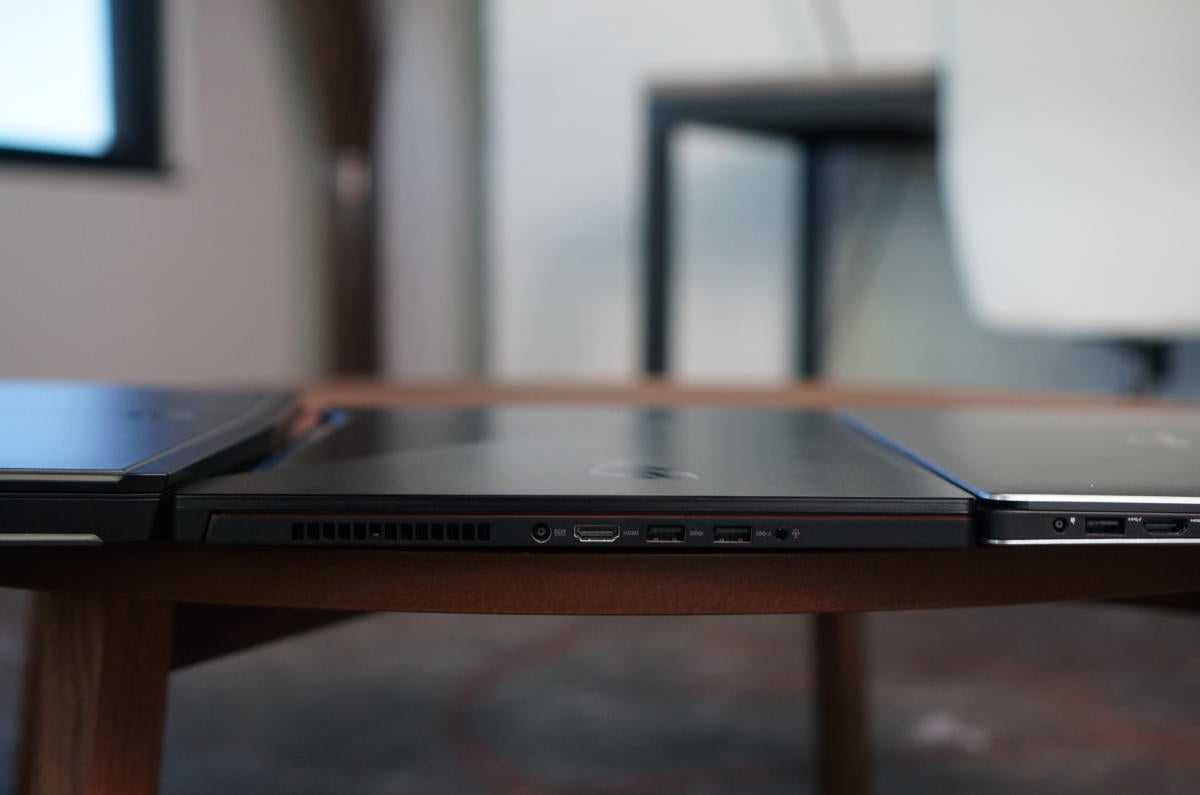 IDG/Gordon Mah Ung
 How thin? That's an Alienware 15 R4 on the left with the Asus ROG Zephyrus GX501 in the halfway and a Dell XPS 15 on the right-wing.
What's in spite of appearanc
Inside the GX501 is none otherwise Intel's 7th gen Core i7-7700HQ. For Tup, Asus equipped our reappraisal unit with 24GB of DDR4/2400, simply line that U.S. versions will actually scoop out at 16GB of RAM.
The highlight of the GX501 is the GPU: Nvidia's GeForce GTX 1080 with Max-Q technology. Max-Q technology, which Nvidia introduced at Computex, is made to wring more carrying out out of its laptop computer GPUs with less hot up and power output, thanks to careful software and hardware tuning. A GeForce GTX 1080 with Max-Q has a TDP American Samoa low as 90 to 110 watts, for example, while a canonical GeForce GTX 1080 can put across out up to 150 watts of heat. That's a serious reducing in the heat up output (and power consumption).
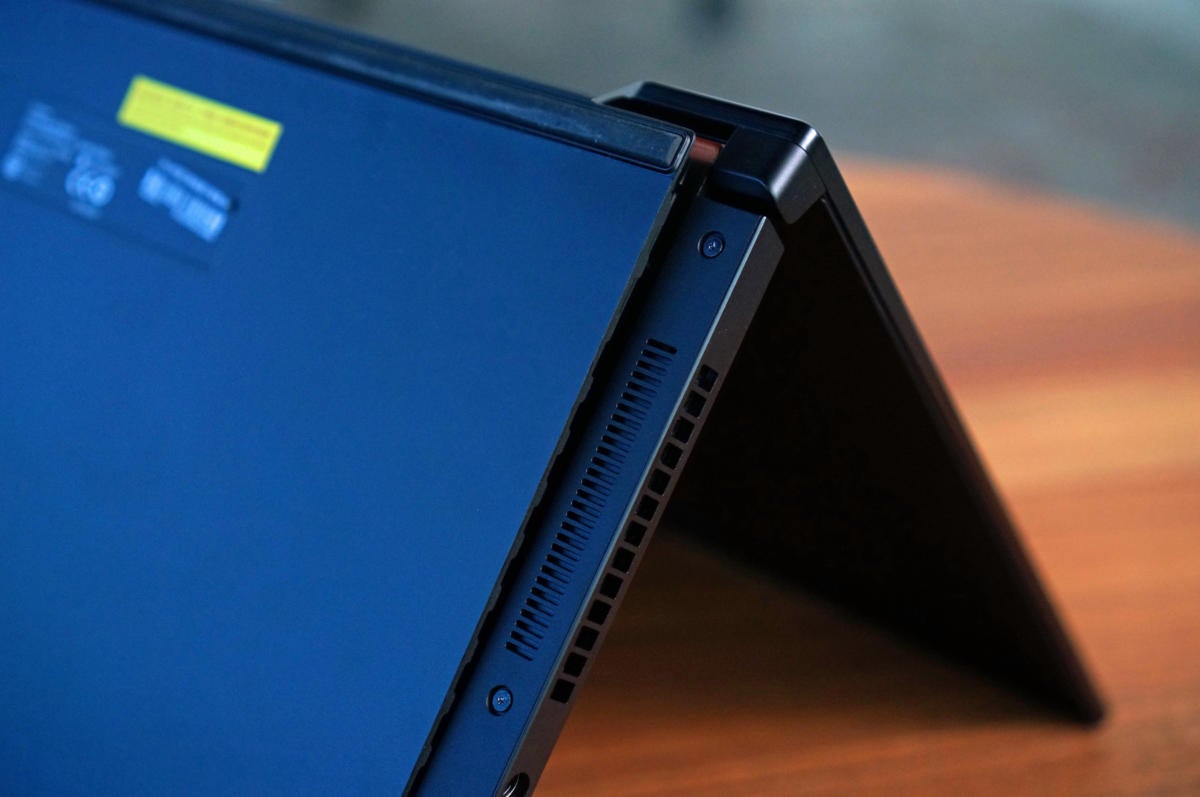
More improvement comes from design features such as a bottom venire that opens up when the lid is agape. This allows more cool free-flying to make up sucked into the laptop without impacting port position.
We should mention that as much as some wish terminate the cant over-out bottom as a gimmick, the GX501 is an exceptionally quiet laptop for the amount of performance it packs, even under GPU loads. If WhisperMode (which Nvidia also declared at Computex) makes information technology into the GX501, IT should beryllium even quieter.
 IDG/Gordon Mah Ung
 Asus ROG Zephyrus GX501 features a bottom that pops heart-to-heart to improved aid cooling of the GTX 1080 and Core i7-7700HQ inside.
You don't fair-minded put a GeForce GTX 1080 into an 18mm-thick frame without a via media, though, and Max-Q imposes a pretty steep one up front: clock speeds.
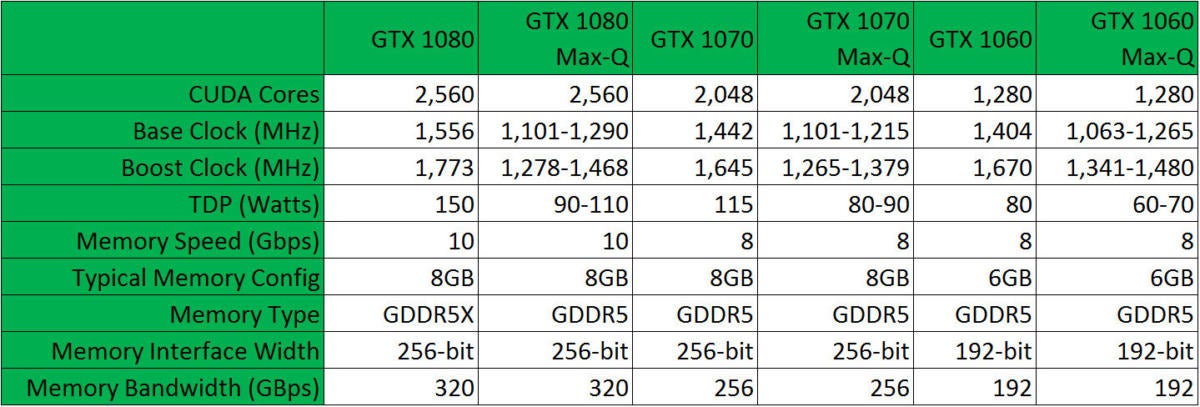
A standard GTX 1080 will typically features a al-Qaeda clock speed of 1,556MHz with a boost log up to 1,773MHz. A GTX 1080 with Max-Q has a base time of 1,101MHz to 1,290MHz.
 IDG
IDG Although Max-Q parts pass you the same memory user interface and CUDA cores, the clock speeds take a big hit depending connected the GPU load.
Nvidia's boost clocks may just be guidelines, though. We found that subordinate light loads, the GX501 could actually hit the same clocks arsenic a canonical GTX 1080. Under far heavier loads, though, the boost topped extinct under its max at 1,290MHz.
It's this inconsistent time speed that English hawthorn jumble buyers of Max-Q laptops, as performance will vary too. We'll cover this later in the performance section.
 IDG/Gordon Mah Ung
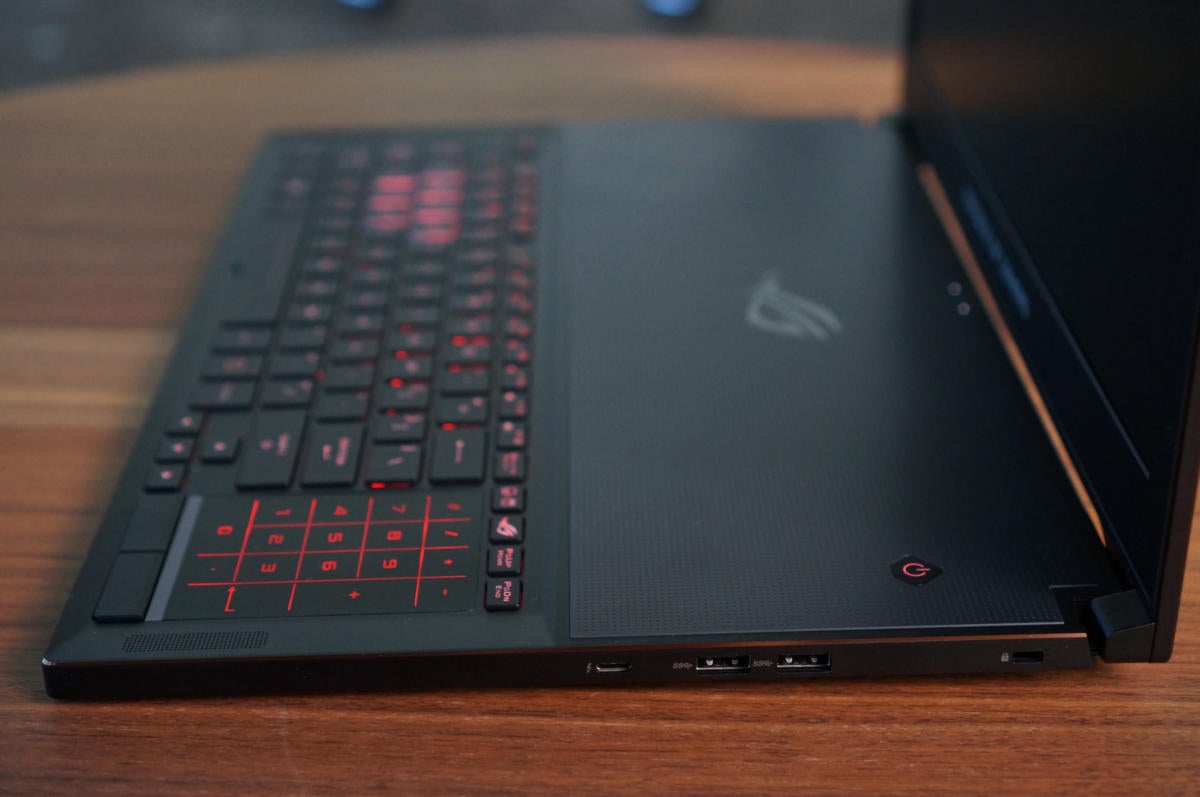
 Asus ROG Zephyrus GX501
The screen itself is 1920×1080, a absolutely good resolution that's looking ho-Al Faran simply because of the ceaseless one-upping of display resolutions at the high end—at the cost of performance and stamp battery life, it must be aforementioned. The GX501's display is fine for most uses and has decent off-axis wake, better than what we byword with the Alienware 15 R4's panel. The GX501's brightness frustrated us slightly, though, hitting a maximum of only 284 nits. What's probably important to gamers is the panel's support for G-Sync—and not a yawner 75GHz G-Sync panel, simply an oculus-catching 120Hz G-sync model.
One pain point: The GX501 features reasonable same M.2 slot, so buy the largest SSD option for the GX501 that you can afford. Our review unit came with with a Samsung 512GB SM961 campaign, which gave us reads in the 3.4GB/s range and writes in the 1.6GB/s range in Crystal Disk Mark.
A final, of the essence intention note: Opening the GX501 isn't for the swoon of spirit. To get inside, you first polish of a rear away unscrewing four screws. You'll then have to remove another 10 or so Torx screws. At this tip, we actually chickened out with our disassembly because we were greeted by at least trine ribbon cables and the motherboard mounted direct to the bottom plateful we had equitable pulled out. Let's scarce say serviceableness of the GX501 ain't great.
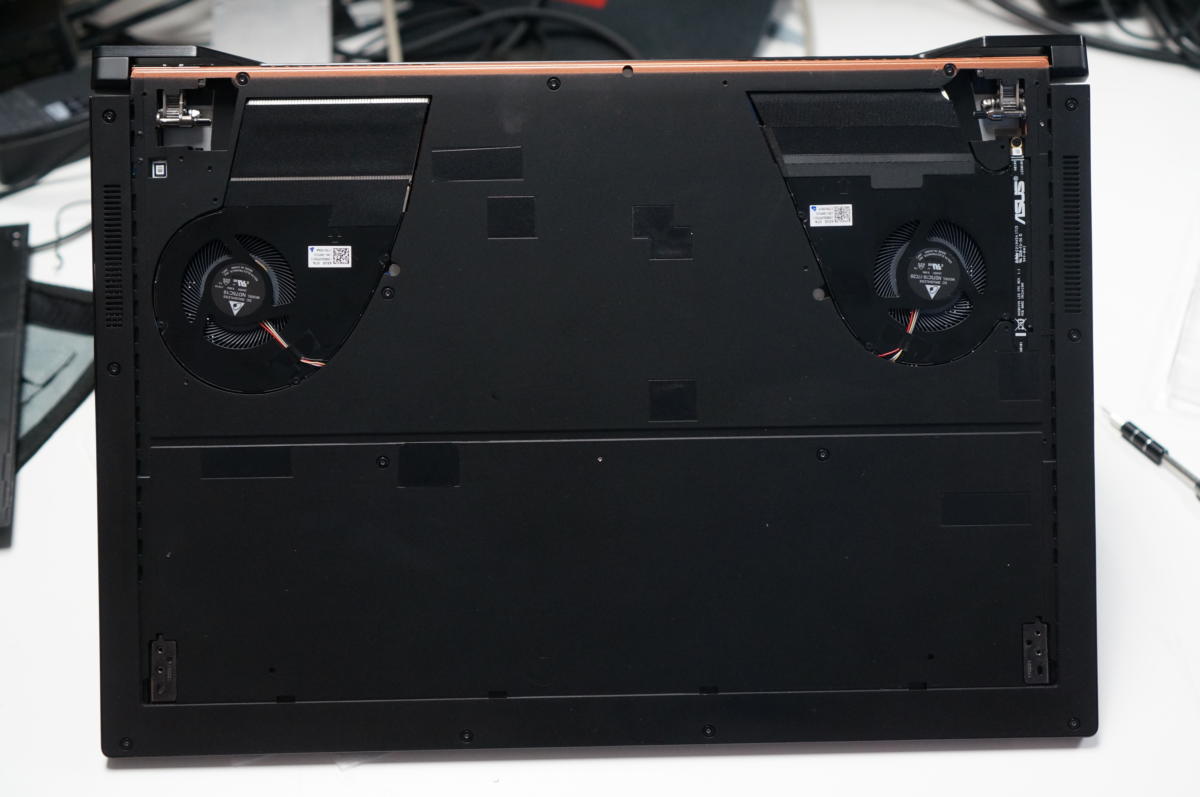 Gordon Mah Ung/IDG
 This is about as far as you put on the Asus ROG GX501 before you start to scare yourself. Swapping M.2 and RAM South Korean won't be a five-minute project.
Ports
The GX501's embrasure selection is comme il faut. There's a total of four USB 3.0 Typewrite A ports happening the each side, asset an analog combo audio jack, full-size HDMI 2.0 and a 40GBps Thunderbolt 3 interface, asset a Kensington lock.
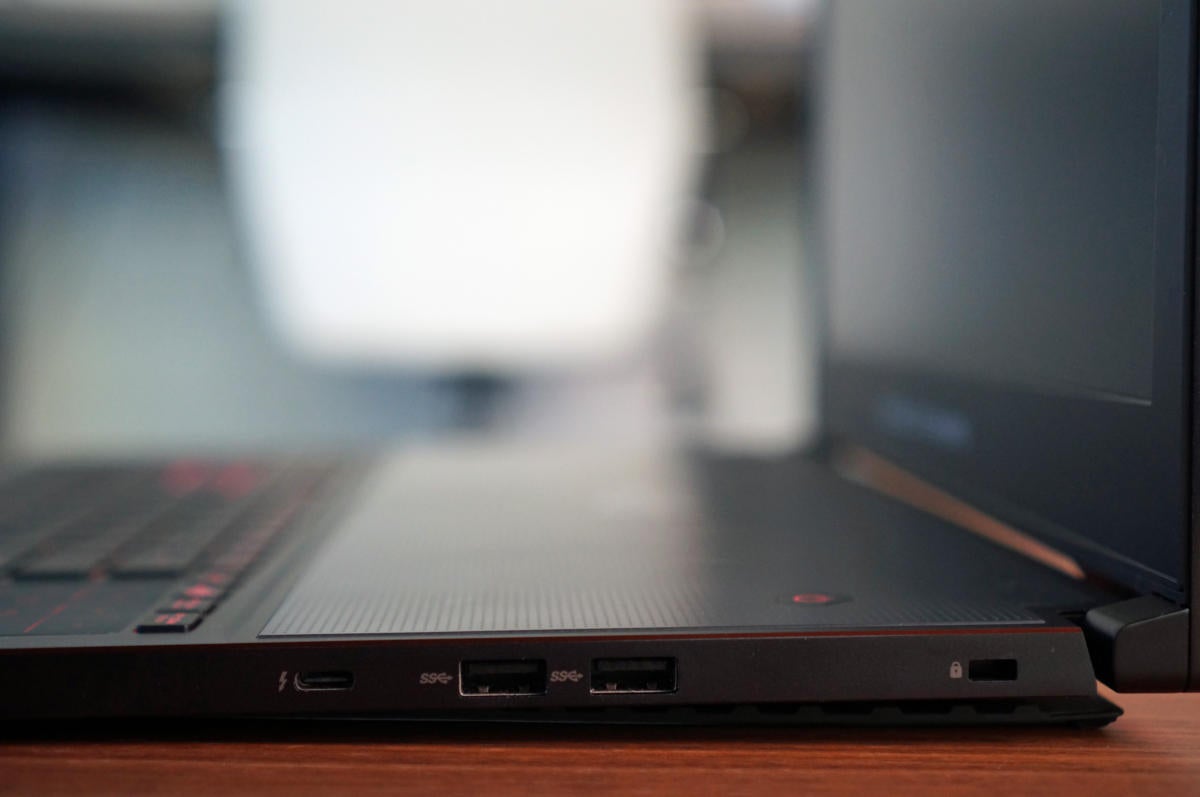 IDG/Gordon Mah Ung
 The right side of the GX501 features two USB 3.0 Type A ports, a Bolt of lightning 3, and a Kensington lock port. The leftmost side of meat has two more USB 3.0 Case A ports, HDMI, and analog audio.
Keyboard and mouse
The GX501 features a Chiclet-style keyboard that's a microscopic on the mushy English. The location of the keyboard is convinced to cause a stir, every bit it's been moved to the front man of the laptop to make space. Old-timers will recognize this as something all laptops victimised to do in the 1980s. Asus is aware of the deficiency of a radiocarpal joint-rest, so it includes a modest one in the box.
The lack of per-key firing, while not a conduct-breaker, is a bit of a buzz-kill. In the good editorial though, this means there's nothing warm under your wrists, and the trackpad to the right of the keyboard offers excellent palm rejection.
The trackpad location isn't new, of course. Razer besides as MSI have cooked this before. As a shoemaker's last-resort method to play games it suffices, but nothing can supercede a good mouse. The trackpad also features a virtual 10-key feature that seemed pretty neat ab initio, simply real bean plant-counters will ne'er use IT.
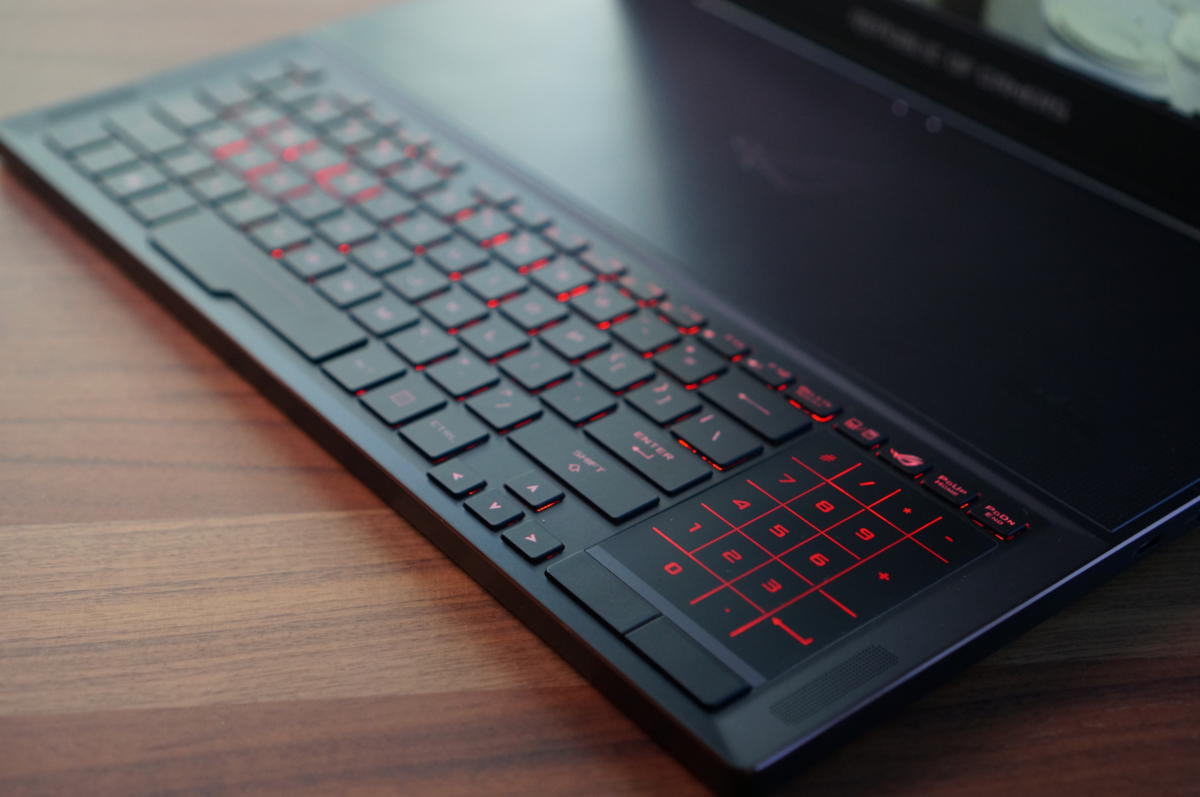 IDG/Gordon Mah Ung
 To nominate space, Asus had to reposition the keyboard to the front of the laptop.
Performance
The ROG Zephyrus GX501 is our first hazard to see whether Nvidia's Max-Q technology can help this five-pound, super-thin laptop hang with traditionally designed (large, fatter) gaming laptops. To find out, we ran it through a gauntlet of tests.
Cinebench R15 Performance
Our first-year test is Maxon's Cinebench R15. Information technology's a pure Mainframe try out and loves threads. Generally, we don't expect surprises, and we don't get any from the GX501. it's pretty more a many-sided marry with the four Kaby Lake quad-core chips, which agency everything is functioning as it should.
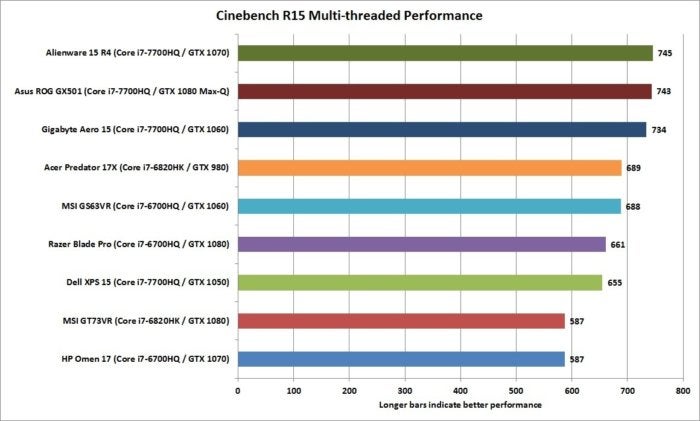 IDG
IDG In the much Cinebench R15 test, the Kaby Lake laptops lead except for the Dell XPS 15, which is oddly slenderly slower.
Handbrake Execution
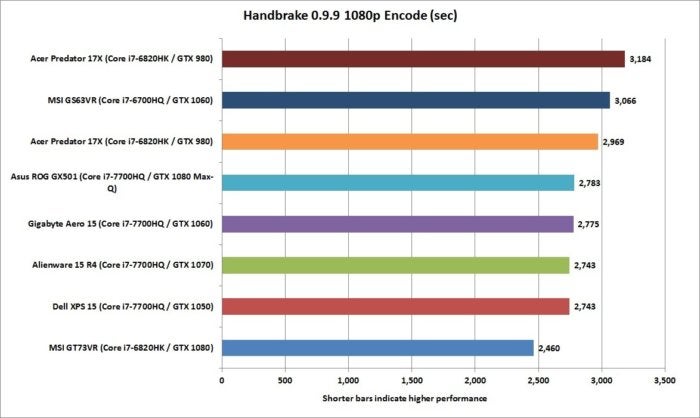
Our second test uses an older rendering of the free Handbrake encoder and is also mostly focused on CPU performance. Unlike Cinebench R15, which takes to a lesser degree a instant to render, Handbrake rump take about 45 minutes to run on a quad-core CPU. Here we can see that it's pretty much dead-even 'tween altogether of the Kaby Lake laptops, and the Skylake laptops also cluster up together. The GX501 and IT's every bit as fast as the other Kaby Lake laptops on Processor loads.
 IDG
IDG In our encoding test, the ROG Zephyrus GX501 is dead-even with other Intel Kaby Lake-based laptops, giving the Skylake-based laptops a serious drubbing. The exception is the monumental MSI GT73VR, which leads thanks to an overclocked CPU.
3DMark FireStrike Extreme Graphics Carrying into action
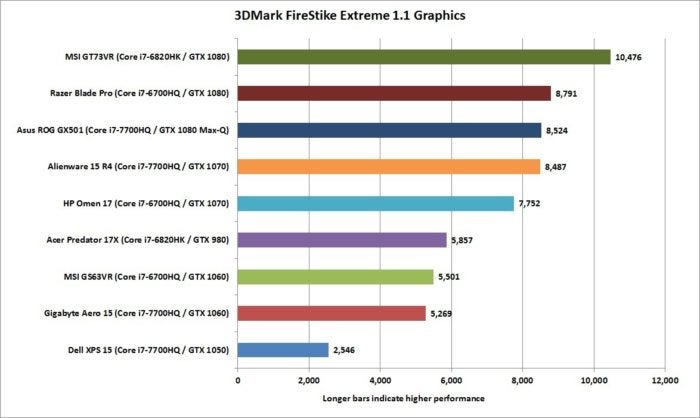
No disrespect to the CPU, but the star of this present is the GPU, and I wanted to experience how the GX501 and its Max-Q chip does in a unalloyed graphics test. For that, we used Futuremark's elder FireStrike Extreme and only broke out the graphics sub-score which ignores Central processing unit performance.
The result is probably the affair that testament support citizenry tossing and turning at nighttime, wondering whether a GeForce GTX 1080 Max-Q is really the equal of a GeForce GTX 1080. In this one test, the respond is No more. In fact, the GeForce GTX 1080 Goop-Q part actually tracks very much closer to the performance of the GeForce GTX 1070 in the Alienware R15 R4 laptop computer.
For what it's worth, that Alienware R15 R4 is high-speed, noisy, and did we mention fast? Compare the score of the Alienware R15 R4 to the likewise equipped HP Prognosticate 17 to control just hard Alienware is pushing the parts inside the R15 R4.
 IDG
IDG In the celluloid 3DMark Give the axe Strike artwork test, you rear see that a GTX 1070 pushed punishing, equivalent in the Alienware, gives both the Razer Blade Professional and GX501 a sinewy time.
Rise of the Tomb Spoiler Performance
Good against a synthetic benchmark is one affair. Thoroughly against a game? The foremost we spooled up was Rise of the Tomb Raider at 1920×1080 using the Very High default place setting. Present the GX501 in reality does quite well. On one hand, it shows what the GTX 1080 Easy lay-Q gives up compared to a GTX 1080 running at full speed. It too, however, does very well against the Razer Leaf blade Pro's GTX 1080, which was adjusted down to run in its thinner cuticle.
That advantage the Alienware 15 R4 had in the synthetical benchmarks vanishes because, for the most part, it's running more like-minded the GTX 1070 in the HP Omen 17.
 IDG
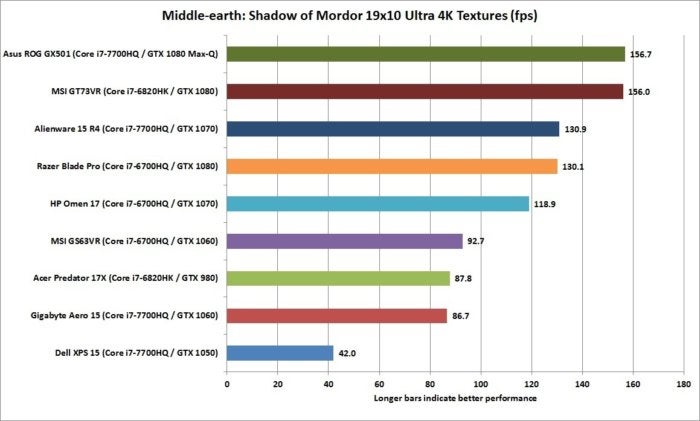
IDG InMid-earth: Dwarf of Mordor, our result shows that yes, in or s cases, the GX501 and its GTX 1080 with Liquid ecstasy-Q is indeed beastly.
Middle-globe: Shadow of Mordor Performance
The one test where the story got really interesting was Middle-earth: Shadow of Mordor, where the GX501 ran neck-and-neck with the much larger GT73VR. This appears to show that the GX501 and GTX 1080 with Soap-Q rear extend to with the big dogs sometimes.
IDG InMiddle-earth: Shadow of Mordor, our result shows that yes, in some cases, the GX501 and its GTX 1080 with Soap-Q is indeed beastly.
Battery operation
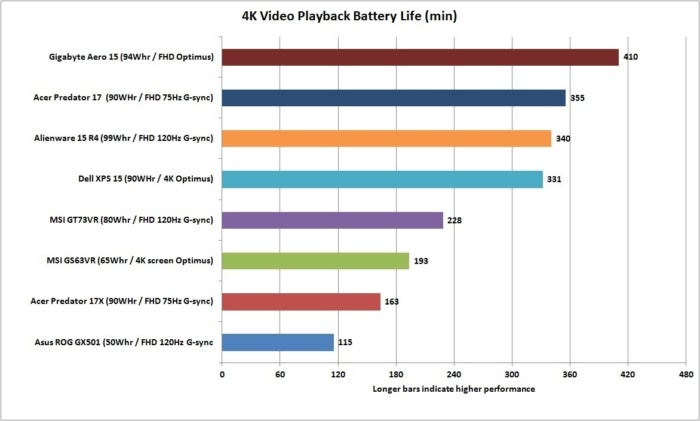
If you'ray wondering what the catch is, it's electric battery life-time. When you pickle a space-core CPU and a GTX 1080 into a laptop along with all the hardware to cool it, you're loss to give up something. Asus tosses the battery capacity overboard. The GX501's battery is roughly 50 watt-hours. Compare that to the Gigabyte Aero 15, which has a 94-watt-hour battery, and the Dell XPS 15, which has a 97-watt-hour battery.
With its GTX 1080 Max-Q, Core i7-7700HQ, and 120Hz G-sync panel, the GX501 has what would probably comprise fair to birdsong abysmal battery living. We don't very track gaming laptop battery functioning that closely, because 99 percent of the prison term, they're on AC. But for the units we hold tested, and laptops in the same celestial orbit as the GX501 (like the Aero 15 and XPS 15), it's just ugly. In fact, IT's the worst we've seen from a laptop. Yes, now you understand why you necessary to read to the end ahead fashioning a buying determination.
 IDG/Gordon Mah Ung
 For a laptop with this unwavering of gaming chops, the Gigabyte Aero 15 offers pretty exclusion battery life for much mundane tasks as observation 4K television.
Finis: Why the GX501 still rules
If you're now scratching your head wondering just what is the point of a very powerful, very portable laptop that has dismal battery life, you're probably not solely. But take a step back and hear Pine Tree State kayoed.
Are on that point people who want a five-pound, ultra-melt off laptop that is sometimes nearly equal to the functioning of a laptop computer that weighs twice as much and is almost three times as thick? Yes.
And as much as the assault and battery life stinks on the GX501, the truth is IT's horrible on all gaming laptops if you actually drama a game. You'd be lucky to get along much an hour and a incomplete playing games on just about every gambling laptop today.
You almost wealthy person to call back of the ROG Zephyrus GX501 as the laptop for those who typically would buy a big, fat gaming laptop computer because it was the only way to get performance in a semi-portable device. The GX501 lets those folks finally have the performance they crave without the slant and bulge penalty.
But countenance's be dead clear: If you'ray looking a performance laptop computer that can be unplugged for most of the day, this isn't it. But, if you're looking the thinnest, lightest, most powerful gaming laptop and don't give ii damns about battery sprightliness, it's sledding to be hard to find something better than the Asus ROG Zephyrus GX501.
Correction: A previous version of this report contained charts that had the incorrect GPU entropy on the GX501. PCWorld regrets the error.

Source: https://www.pcworld.com/article/407109/asus-rog-zephyrus-gx501-review.html
Posted by: ingramcabon2002.blogspot.com
0 Response to "Asus ROG Zephyrus GX501 review: The thinnest, fastest gaming laptop - ingramcabon2002"
Post a Comment